
Join Our Newsletter for Cozy Home Inspiration, Family Fun, and Delicious Recipes Every Week
Best Man Cave Office Ideas That Finally Made My Husband Stop Working From the Couch

Disclaimer. Some images featured in this post may originate from third-party sources and are used for illustrative purposes only. Please review our Image Credits Policy for attribution information.
I walked past the spare room for the hundredth time, carrying a laundry basket, and finally said out loud what I had been thinking for months: that room needed to become something. “Man cave office” was not the phrase I used at the time, but it was exactly what my husband needed.
He had been working from the kitchen table for over a year, laptop balanced next to the fruit bowl every single morning. It worked, technically, but it never felt like an actual workspace.
I remember standing in that spare room, still half full of boxes, trying to picture what would make him actually want to sit in there for eight hours a day. Nothing about it felt inviting yet.
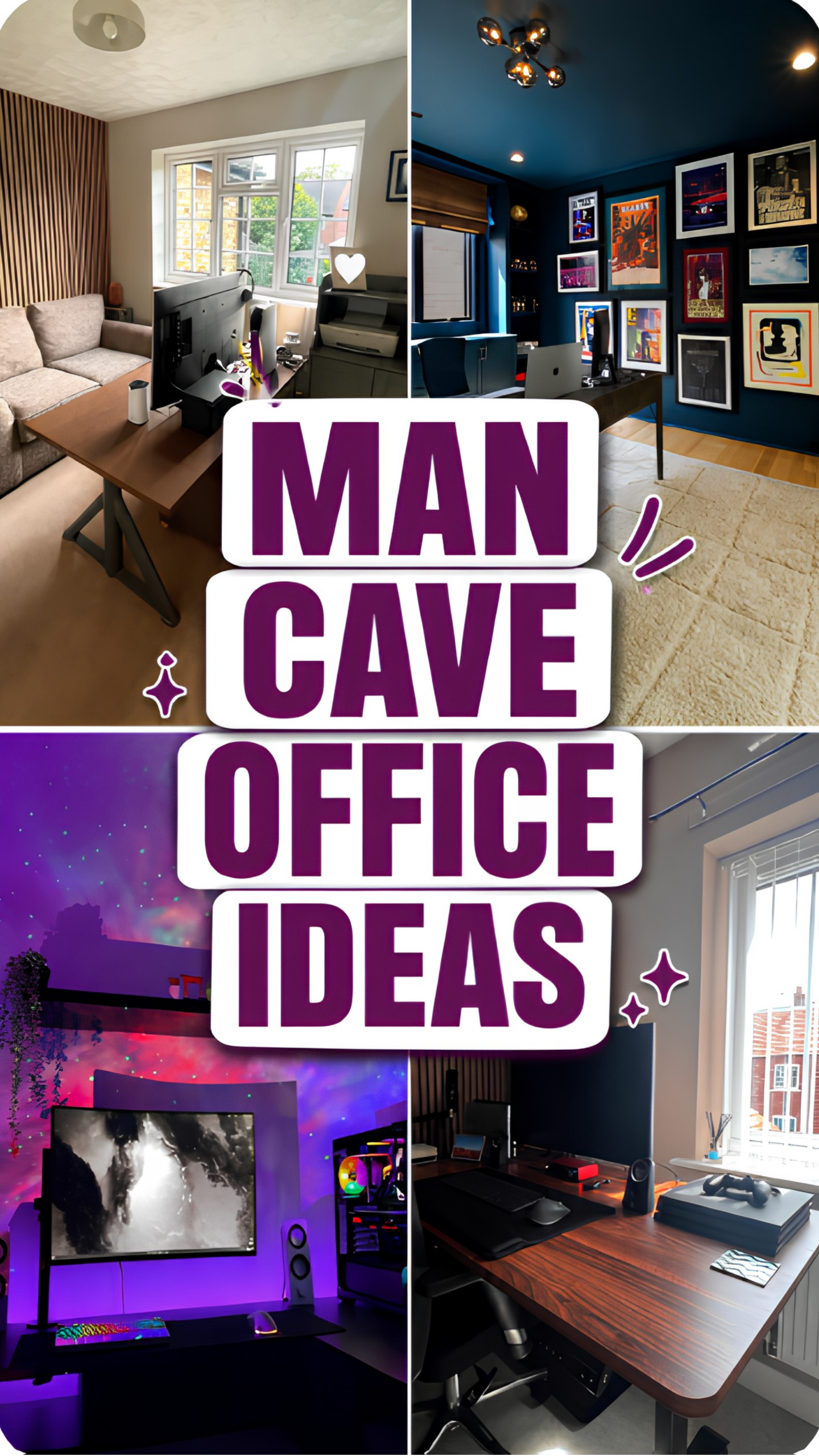
That night I started looking through home office setups built specifically with a guy in mind, since the usual soft, airy office inspiration never seemed to fit what he wanted. What I found surprised me with how different each version felt.
Some leaned moody and dark, almost like a private study. Others went bold with color and personality on full display. A few kept things simple but warm, built around wood and good lighting instead of anything flashy.
I started saving the ones that felt closest to how he actually lives, not just how a magazine says a home office should look. That distinction mattered more than I expected once we started planning.
We picked pieces slowly instead of buying everything in one trip. Some choices worked immediately once the room came together. Others needed adjusting before the space felt finished.
What surprised me most was how much a dedicated space changed his whole attitude about the workday. It stopped feeling like he was just tolerating a desk in the corner and started feeling like he had somewhere that was actually his.
I noticed the shift in small ways first, him closing the door at the end of the day instead of leaving his laptop open on the counter all evening. That boundary alone was worth the whole project.
I am sharing the six ideas that shaped his space the most. Everyone came from a real setup I admired online before we ever tried a version of it ourselves.
What We're Exploring
- 01 A Moody Dark Palette Turns a Small Room Into a Private Study
- 02 A Simple Desk Corner Proves a Man Cave Office Does Not Need a Whole Room
- 03 Mom Notes
- 04 A Full Gallery Wall Turns a Home Office Into a Personal Museum
- 05 A Reclaimed Wood Wall Brings Warmth to a Basement Office
- 06 An Ambient Light Show Turns a Desk Into a Gaming Escape
- 07 A Warm Wood Desk Keeps a Minimalist Setup Feeling Grounded
- 08 What Building a Room He Actually Wanted to Use Taught Me About Home
A Moody Dark Palette Turns a Small Room Into a Private Study
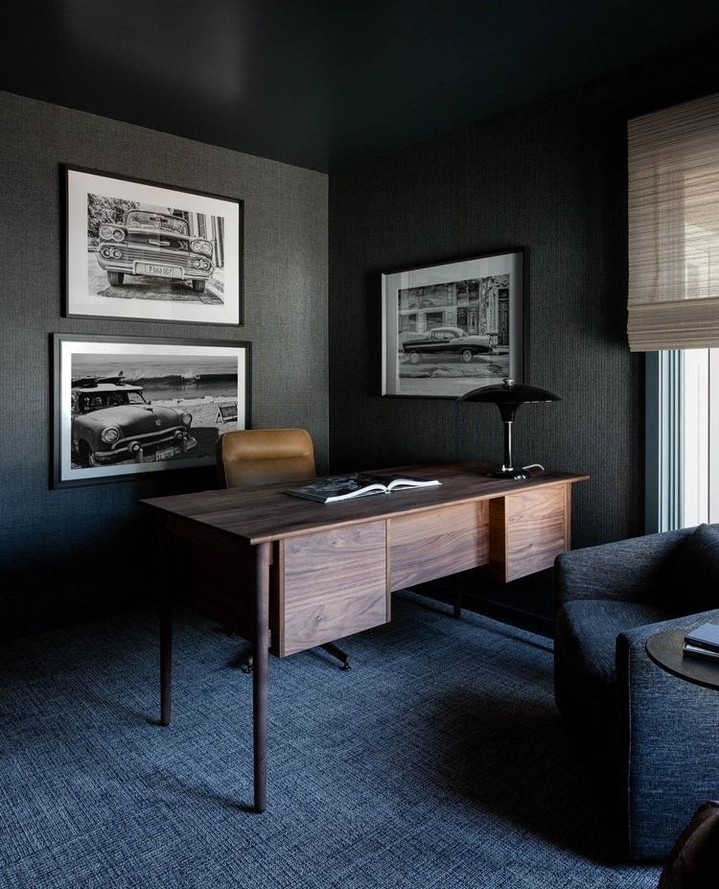
Painting the walls, trim, and even the ceiling one deep charcoal or navy shade turns an ordinary spare room into something that feels like a private retreat rather than a leftover space. The dark backdrop makes framed black-and-white photography pop in a way a white wall never could. This kind of confident color choice is a favorite starting point for a man cave office built around mood over brightness.
Sticking to warm wood furniture against the dark walls keeps the whole room from feeling cold or overly formal. A single sculptural desk lamp adds a pool of warm light exactly where it is needed most for evening work. That contrast between dark walls and warm wood is a technique borrowed from moody interior design trends that favor depth over brightness.
Budget Note: Dark charcoal or navy paint typically runs $40 to $60 per gallon at Sherwin Williams or Benjamin Moore, with framed art adding $30 to $80 per piece.
A Simple Desk Corner Proves a Man Cave Office Does Not Need a Whole Room
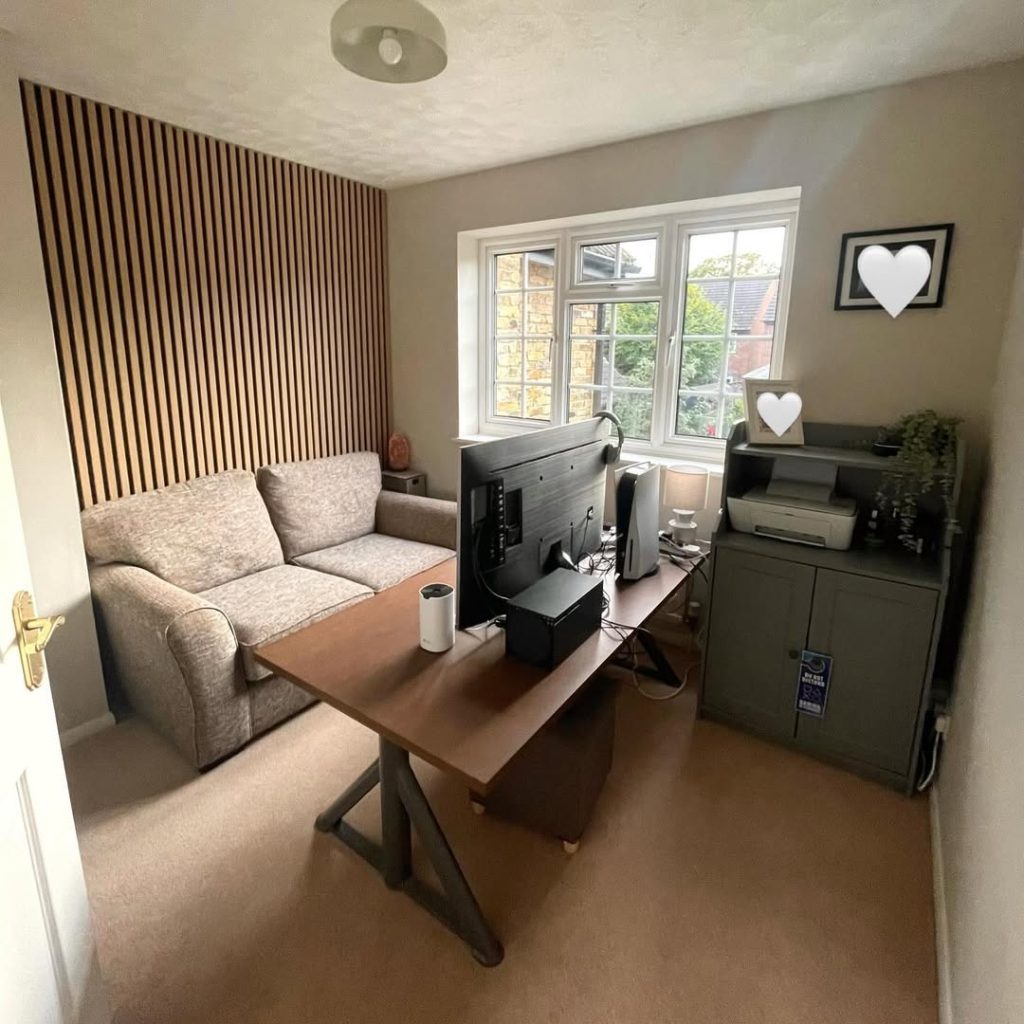
Tucking a compact desk into the corner of a shared living space proves a man cave office does not require an entire spare room to feel legitimate. A slatted wood accent wall behind the desk gives the corner its own visual identity, separating it from the sofa just a few feet away. That small architectural distinction does a lot of work in a limited footprint.
This setup also works well for anyone renting or living in a smaller home where a dedicated room simply is not an option. A single accent wall and a well-chosen desk go a long way toward making a shared space feel purposeful. It proves that scale matters less than intention.
Budget Note: A slatted wood accent wall panel kit typically runs $60 to $120 at Amazon or a specialty retailer, with a compact desk adding $100 to $200 at IKEA.
Mom Notes
Let the space reflect what he actually likes, not just what looks good online. A few personal items, old photos, favorite records, a guitar he actually plays, do more for a room than any trend ever will. Good lighting matters more than most people expect, so budget for a real desk lamp before anything decorative.
A Full Gallery Wall Turns a Home Office Into a Personal Museum
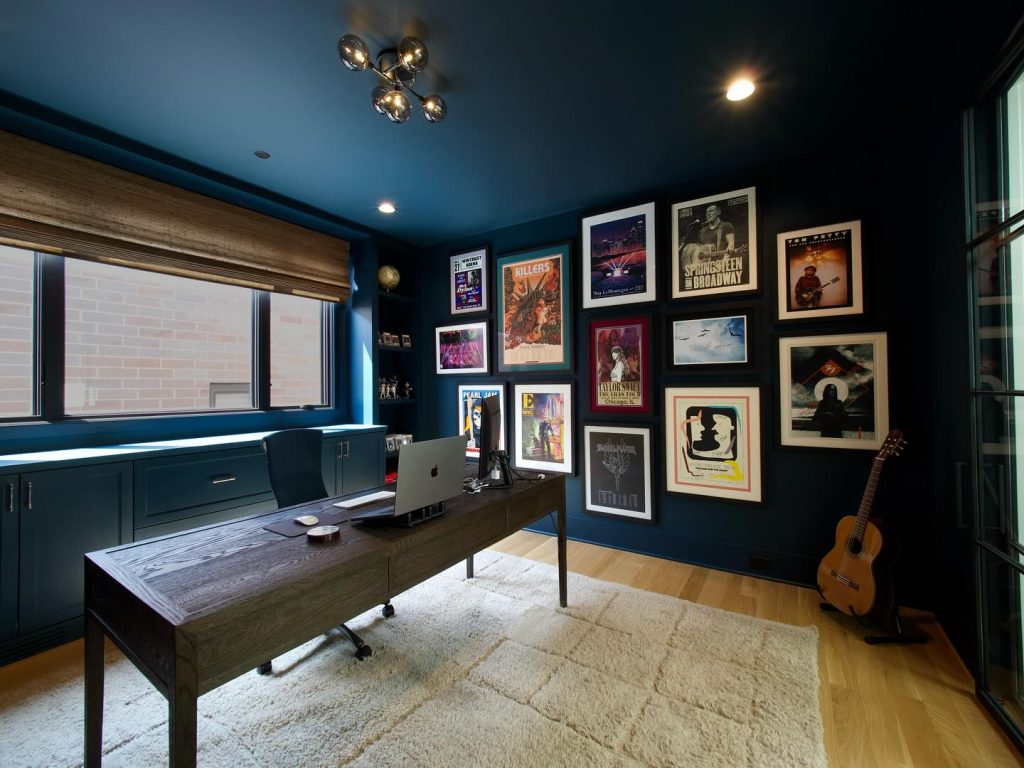
Covering an entire wall in framed concert posters, album art, and personal memorabilia turns a home office into something that feels like a genuine reflection of one person’s taste. A deep teal wall color makes every frame stand out with real contrast. This kind of full commitment to personal collection is what makes a man cave office feel authentic rather than staged.
Leaving a guitar out on a stand nearby, rather than tucked in a case, adds a lived-in touch that a purely decorative room never achieves. A plush area rug and warm sculptural lighting soften what could otherwise feel like a stark, gallery-style room. That balance between bold walls and soft furnishings keeps the space comfortable to actually work in.
Budget Note: Frames for a full gallery wall typically run $15 to $40 each at Target or Michaels, with a large area rug adding $150 to $300.
A Reclaimed Wood Wall Brings Warmth to a Basement Office
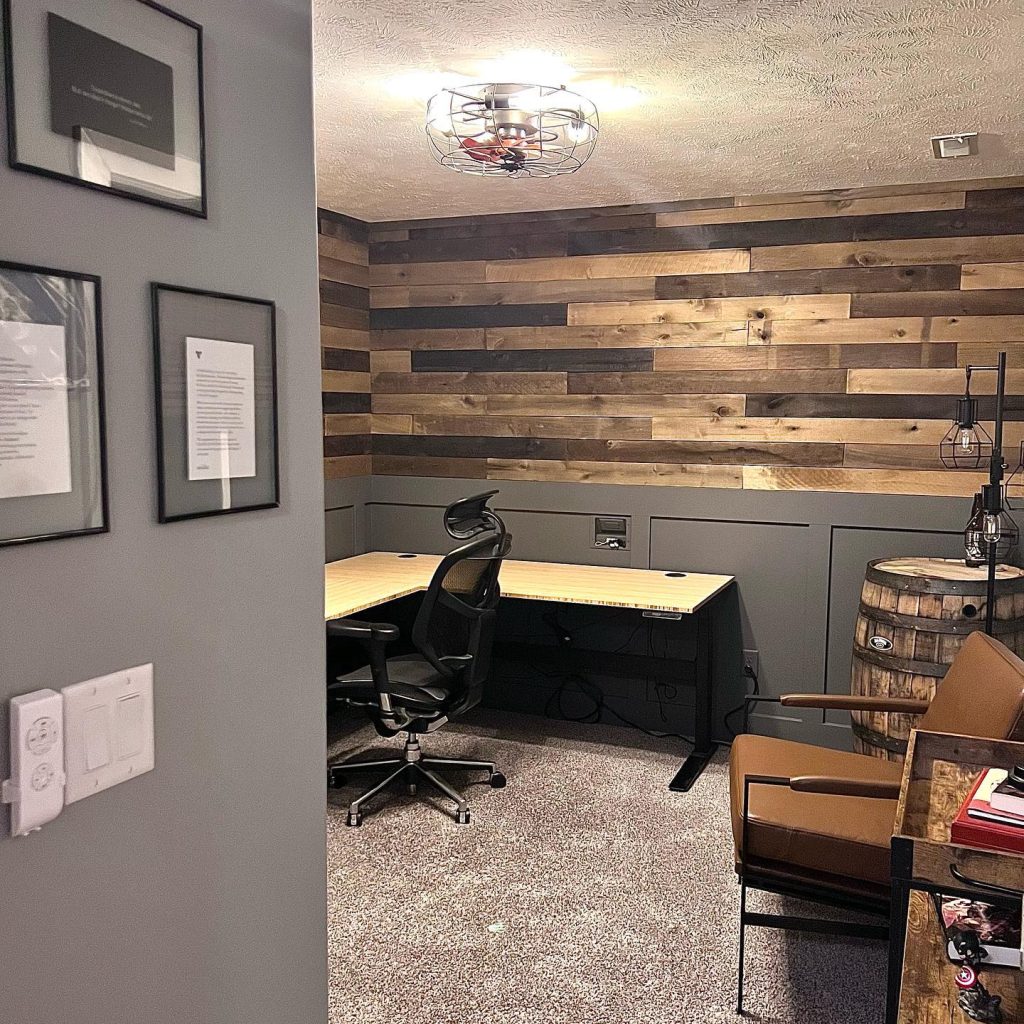
Covering a lower-level wall in mixed-tone reclaimed wood planks solves the common problem of a basement office feeling cold or unfinished. The varied wood grain adds texture and warmth that plain drywall never provides in a room without much natural light. This kind of material choice is a signature move in a man cave office design built underground.
Pairing the wood wall with a wine barrel side table and a leather armchair leans into a rustic, lodge-inspired feel without tipping into anything overly themed. Industrial cage-style lighting adds character while still providing the practical task lighting a real workspace needs. That mix of textures is what keeps a basement office from feeling like an afterthought.
Budget Note: Reclaimed wood wall paneling typically runs $80 to $150 per section at a specialty lumber supplier, with a leather accent chair adding $200 to $400.
An Ambient Light Show Turns a Desk Into a Gaming Escape
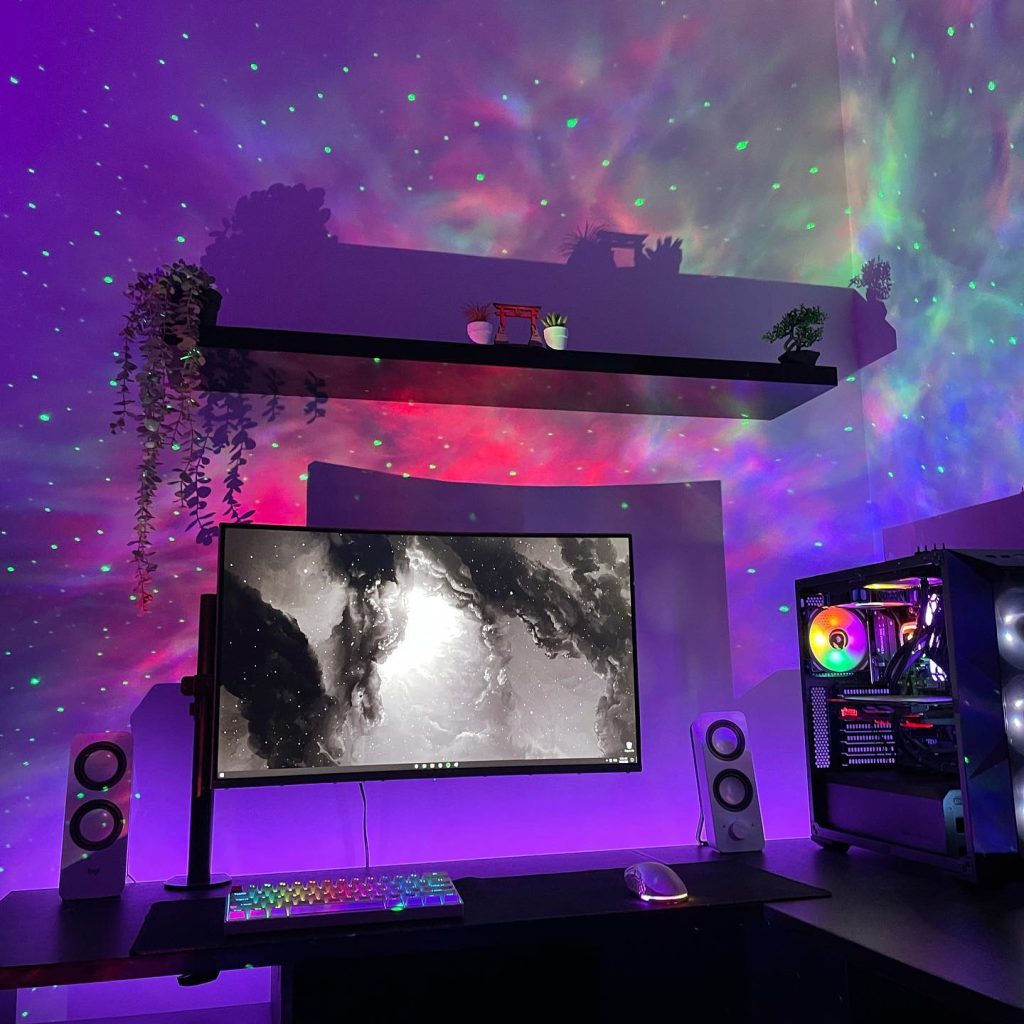
Adding a galaxy-style light projector above a gaming desk turns an ordinary corner into an immersive escape once the sun goes down. The shifting colors across the ceiling and walls create a whole atmosphere without needing a single piece of new furniture. This kind of playful, tech-forward setup is a favorite version of a man cave office for anyone who games as much as they work.
Trailing plants on a floating shelf above the desk soften all that color and light with a bit of real greenery, keeping the space from feeling purely artificial. A tower PC with visible RGB fans becomes part of the decor rather than something to hide away. That transparency, letting the tech be seen, is part of the appeal for this style.
Budget Note: A galaxy light projector typically runs $25 to $45 at Amazon, with RGB desk accessories adding $30 to $80 depending on the setup.
A Warm Wood Desk Keeps a Minimalist Setup Feeling Grounded
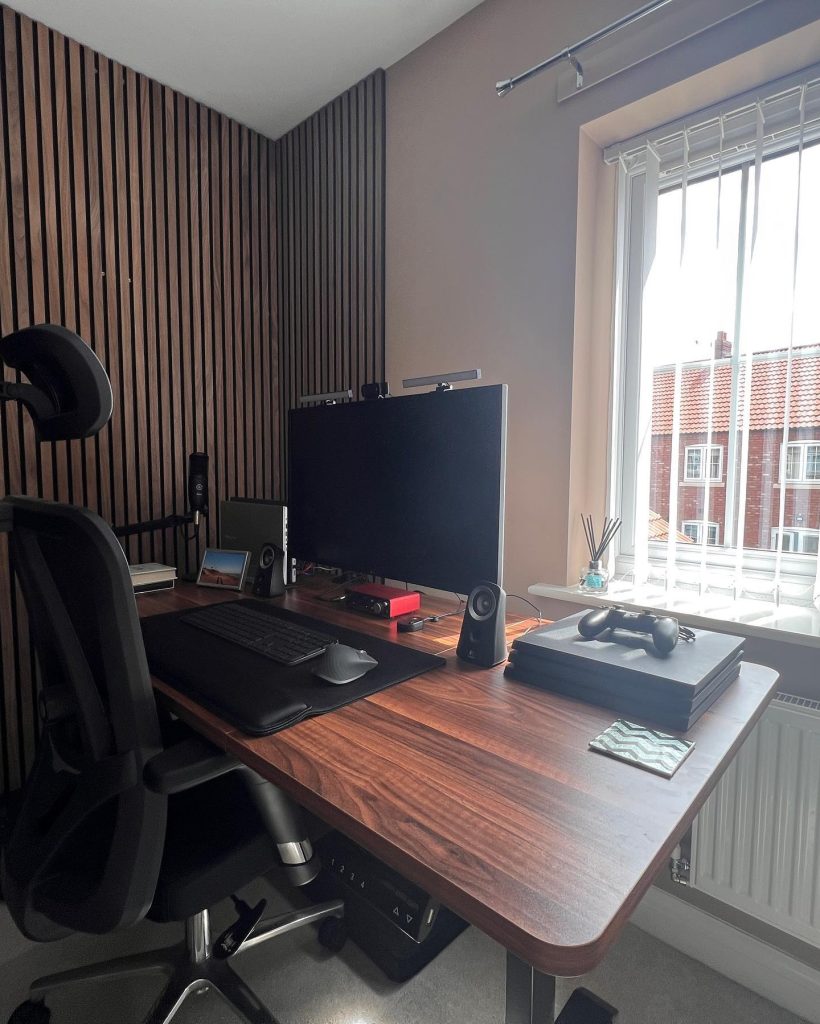
A single rich walnut desk, kept clear except for a monitor and a few essentials, proves that a man cave office does not need heavy decoration to feel finished. The natural wood grain does most of the visual work on its own against a plain wall. Good natural light from a nearby window keeps the whole setup feeling calm rather than sparse.
Adding a diffuser with reeds and a small framed photo brings just enough personality without cluttering the clean lines of the desk. A standing desk converter underneath allows the whole setup to shift between sitting and standing throughout the day. That kind of practical flexibility matters for anyone spending long hours at the same desk.
Budget Note: A solid wood desk typically runs $250 to $500 at a furniture retailer, with a standing desk converter adding $100 to $200.
What Building a Room He Actually Wanted to Use Taught Me About Home
That spare room sat half finished for longer than I want to admit, mostly because neither of us could agree on what it should actually become. It took longer than expected to land on a direction that felt right.
I used to think a home office just needed a desk and a door that closed. A real man cave office taught me that the details, color, lighting, and personal touches are what actually make someone want to spend time in a room.
There is something satisfying about watching a space go from a catch-all storage room to somewhere with a clear purpose. It changes how the whole house feels, not just that one room.
My husband started closing his laptop at the end of the day instead of leaving it open on the kitchen counter all evening. That small boundary made a bigger difference to our whole household than I expected.